An interview with:
Rina Razanakolona, Director of UEBT Madagascar
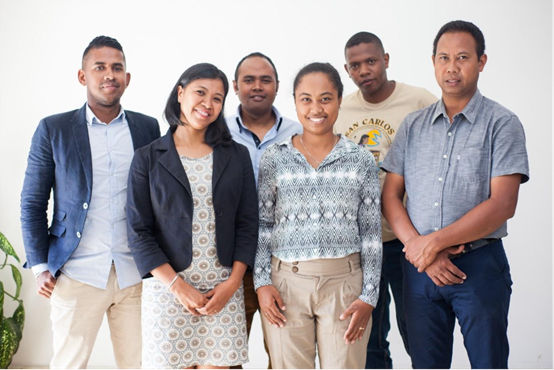
Rina (front row, left), and part of her Madagascar team.
1. How long have you been working for UEBT and what made you want to work with this organisation?
I have been working for UEBT for 7 years now, but I started collaborating with the organisation way earlier than that, since 2011. I would never have imagined back then that I could, one day, work for UEBT!
I first heard about the organisation in 2010. At that time, I was working for an NGO in Madagascar, which was a UEBT affiliate member, and we made a project proposal on adults’ literacy for a grant, which was approved by UEBT. I remember looking at the UEBT website searching for information and being very admirative of their "progressive approach", which I found realistic, and which I think gives more "room" for deeper improvements and implementation.
Before I started as a full-time job at UEBT in 2016, I collaborated on several UEBT projects such as organising a workshop with local communities on Biocultural Community Protocol in Madagascar, translating the UEBT community kit in Malagasy, participating to the UEBT standard consultation during the revision process in 2011, organizing a workshop on Centella asiatica etc.
2. Can you tell us what is your role at UEBT and what is the role of the Malagasy office that you are supervising?
I am UEBT Madagascar Representative, supervising the UEBT Malagasy office composed of eight people. We are the main contact for companies, partners and governments who work or wish to work in Madagascar in natural ingredients supply chains.
In our daily work, my team and I are promoting the UEBT standard by:
guiding Malagasy companies on UEBT membership and certification processes
performing assessments against the UEBT standard for both UEBT certification and verification programmes
implementing social and biodiversity related projects in the field such as vegetable gardens, school kits distribution, school infrastructures rehabilitation, restoration, and reforestation activities, etc.
3. You are among the ones that have worked the longest at UEBT. What are some of the improvements you have seen over the years in the companies that UEBT works with in Madagascar and that you are proud of?
I am proud of what companies have achieved so far when implementing our standard. I can really witness that, improvements have taken place especially in the areas of supply chain structuration, product quality, traceability, workers well-being and relationship with communities in the sourcing areas.
4. Sought-after raw materials by the flavour and cosmetics sectors such as Vanilla or Centella Asiatica are grown in Madagascar yet Malagasy smallholder farmers are facing a lot of social challenges especially in the remote villages where those natural ingredients are grown. Can you tell us a bit more about those challenges and what kind of best practices UEBT is promoting to improve the livelihoods of these farmers?
Indeed, Malagasy small holder farmers are facing social challenges, but these challenges are different for Vanilla and Centella sourcing areas. Vanilla farmers have a higher standard of living than Centella pickers. So, while UEBT is encouraging companies to start reflecting on how to reach a living wage for Vanilla farmers, for Centella, on the other hand, where pickers are very poor, UEBT recommends companies to pay an equivalent of the minimum wage and implement income diversification activities. In Centella sourcing areas there is also a risk that pickers' poverty leads to having children picking and selling the leaves instead of going to school. Children have generally limited access to education there. To promote changes on the ground, UEBT also encourages exchanges between the companies and communities in their sourcing areas to identify what are the local needs with the aim of contributing to improving the situation in the field.